
The digital twin
When assumptions become visible, ambiguity ends

This is Article 6 in a nine-part series: The Urban Professional in the Age of AI, based on The Urban Operating System.
1. The gap · 2. Three paradigms · 3. The machine room · 4. Project memory · 5. Options and numbers · 6. The digital twin ← you are here · 7. Participation · 8. Five levels · 9. The question behind the tools
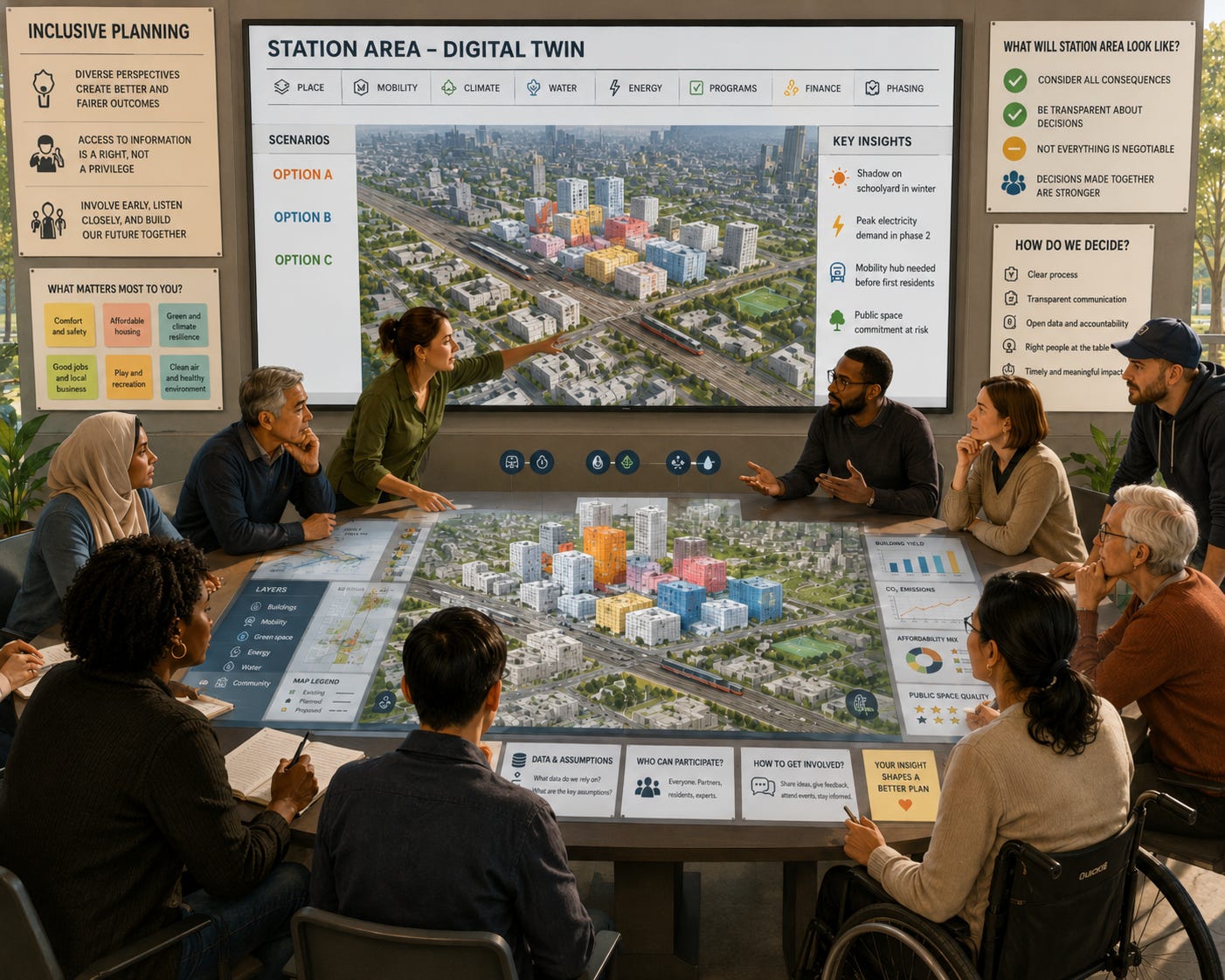
A planning team opens the digital twin of a station area on the morning of a steering group meeting.
The model is impressive.
The station is there. The tracks are there. The planned housing blocks are there, coloured by phase. The public space layer shows the new square, the cycling routes and the line of trees along the main street. The mobility layer shows parking demand. The climate layer shows heat stress. The water layer shows where heavy rain collects. The energy layer shows the grid constraint that everyone knows about but no one wants to make central yet.
The team loads three programme options.
Option A adds density close to the station. The model shows a better housing yield and stronger land revenue, but also more shadow on the schoolyard in winter and a sharper peak in electricity demand during phase two. Option B protects more public space and reduces construction risk, but weakens the affordability mix. Option C keeps the political promise on affordable housing, but only if the parking ratio is lowered and the mobility hub is delivered before the first residents arrive.
For the first time, the team can see the problem together.
That is progress.
It is also the risk.
A digital twin makes a contested future look present. It turns assumptions into images. It gives uncertain relationships the appearance of a system. It lets councillors, residents, developers and public agencies point at the same screen and believe they are looking at the same problem.
The twin has not decided.
It has changed the room in which the decision is made.
A digital twin is not a better picture
The first mistake is to treat the digital twin as a visualisation tool.
That is understandable. The visual layer is what people notice first. Buildings can be rotated. Flood depths can be coloured. Shadow can move across a public square. Traffic flows can be animated. A future neighbourhood can be made visible before it exists.
But if that is all the twin does, it remains a more expensive version of the presentation.
A serious urban digital twin links place, data, assumptions and decisions. Visibility is a byproduct. Consequence is the point.
Michael Batty describes digital twins in city planning as covering a wide range of models, from aggregate economic and behavioural processes to local simulations and detailed spatial models. The central issue is how scientists, policymakers and planners interact with real cities through these models: to understand, predict and design.1
A useful minimum definition follows from that. An urban digital twin is a digital representation of a physical urban system, made up of entities and relationships over time, used to simulate possible changes and inform decisions. Without relationships between layers, without the time dimension and without a defined decision purpose, it is a model, a map or a dashboard. Something useful, but different.
The distinction matters in practice. A digital model is updated manually. A digital shadow receives data from the physical world automatically, but mainly in one direction. A digital twin goes further: it connects data, models, assumptions and decisions in ways that allow change in one layer to affect another. In urban planning, that bidirectional flow is usually not a machine acting on the city. It is a decision being forced to see its consequences.
If we add 1,200 homes to this station area, what happens to school capacity, mobility demand, shadow, heat, water storage, energy load, construction phasing and public space quality? If we lower the parking ratio, what has to be true for the mobility system to hold? If the housing association can no longer carry the same share of risk, which programme commitments become vulnerable? If the water authority updates its climate scenario, which earlier design choices must return to the table?
The digital twin becomes useful when it can hold those questions in relation to each other.
That is why the twin belongs after the previous article on options and numbers. Article 5 argued that AI widens the option space and makes load-bearing assumptions visible earlier. The digital twin is where that option space becomes spatial, shared and testable.
The twin is not an answer machine.
It is the room in which the answer becomes harder to hide.
The twin is where layers meet
Urban development is full of layers that are usually handled separately.
The financial model sits with the planeconomist. The mobility assumptions sit with the traffic advisor. The phasing logic sits with the project manager. The legal commitments sit in agreements and council decisions. The public space ambition sits in design documents. The participation history sits in summaries. The energy constraint sits partly with the grid operator, partly with the municipal energy team, partly in everyone’s anxiety.
Each layer is rational on its own terms. The problem is that the decision is not made in one layer.
A higher density option changes the financial result, the construction sequence, the energy demand, the sunlight impact, the school pressure and the political story. It is not only a design move. A lower parking ratio changes target groups, marketability, public space, residual land value and the credibility of the promise that residents will not simply push parking into adjacent streets. It is not only a mobility choice. A climate adaptation measure changes maintenance costs, public space design, heat comfort, biodiversity, land allocation and sometimes the number of homes that can be built. It looks like a water choice. In practice it is not.
The promise of the digital twin is that these relationships become visible before the decision is already politically locked. Not that it knows all of this perfectly. It does not.
In the old workflow, disciplines often work sequentially. A design option is developed, then tested, then adjusted, then retested. Each round takes time. Each discipline adds its view. The decisive trade-off emerges late. In the digital twin workflow, the team can test earlier. Not finally. Not perfectly. Earlier.
A massing change can trigger a first daylight check. A phasing change can trigger a first infrastructure dependency check. A programme change can trigger a first school capacity and energy load check. A public space reduction can trigger a commitment check against the participation record.
The early result is a warning system, not a final truth.
In asset management, digital twins are valued because they shift organisations from break-fix to predict-prevent. Urban planning needs a similar shift. Not because the city can be operated like a machine, but because many failures are visible before they become crises: an unfunded mobility hub, an outdated grid assumption, a public space commitment without a maintenance budget, a phasing choice that moves risk into a later political term. The twin is useful precisely when it helps the organisation see those failures early enough to act.
This is where AI matters. The twin holds structured data and models. AI makes them queryable. It lets a project director ask in plain language: show me which assumptions change if we move 300 homes from phase three to phase two. It lets a councillor ask: which option best protects the affordable housing commitment, and what does that cost elsewhere? It lets a resident group ask: how does this revised mobility plan affect walking routes to the primary school?
Without AI, the twin remains dependent on specialists who know how to operate it. With AI, access shifts from who knows how to run the model to who is allowed to question it.
From specialist instrument to governance workspace
Most planning organisations that have experimented with digital twins have treated them as specialist instruments.
The GIS team builds them. The data team maintains them. The consultants demonstrate them. The project team uses screenshots in presentations. Councillors see the output, not the working environment. Residents see a polished view, not the assumptions behind it.
That model has limits.
It keeps the twin technically impressive and institutionally weak. The people who most need to understand the trade-offs remain outside the actual model. They receive a translation of the twin rather than access to it as a decision space.
A governance workspace works differently. But first, a word about what it is not.
The smart city tradition often describes digital systems as an urban nervous system: sensors observe, algorithms analyse, infrastructure responds. That metaphor works for traffic lights, pumping stations and energy grids. It works less well for planning. A city has competing publics, fragmented ownership, overlapping jurisdictions and political disagreement. The digital twin should therefore not be treated as the city’s control system. Its public value lies in showing what a decision takes for granted, who can question it and what changes when it is challenged. The public interest has to be represented inside the model, not only in the meeting after it.
The smart city tradition often prizes speed: real-time sensing, instant response, automated adjustment. Urban planning needs a different ideal. Many planning choices are slow for a reason. They involve rights, losses, future obligations and democratic accountability. The useful twin is not always the fastest twin. Sometimes its value is that it slows the room down enough to see the consequences before a decision hardens.
There are three versions of this. A technical twin is used by specialists. A project twin is used by teams and partners to test choices. A civic twin goes further: assumptions can be challenged, scenarios contested and decisions traced by actors with real standing. Most twins will not reach that level. Many should not, because the governance conditions are not in place. But the direction matters.
Open in this context does not mean everyone can change everything. That would be irresponsible. It means different actors can ask questions, see the assumptions relevant to their role, understand the evidence base and challenge what the model is doing.
A water authority can add a revised climate assumption and show its effect on the design. A housing association can test whether a programme option still meets its financing and management constraints. A mobility department can show the dependency between parking reduction, public transport frequency and the timing of a mobility hub. A neighbourhood group can see whether an earlier commitment on public space has been preserved, changed or quietly traded away. A councillor can see that the option labelled “balanced” is only balanced because three risks have been pushed into later phases.
The twin does not remove disagreement. It gives disagreement a more precise object.
The European Commission’s Local Digital Twin Toolbox is moving in this direction by presenting local digital twins as modular, standards-based tools that help cities simulate, analyse and plan urban environments, with an emphasis on interoperability, openness and scalability.2 That matters because the twin only works as a public decision room if data and tools can connect across systems. A closed visual platform may look like a digital twin. Institutionally, it may function like a vendor-controlled presentation layer.
The distinction is political, not technical.
Who can ask questions of the model? Who can see the assumptions? Who can challenge the data? Who decides which indicators matter? Who benefits when the model becomes the accepted version of the project?
The digital twin becomes a decision room only when those questions are answered explicitly.
There is one more reason why those questions meet resistance.
Precision is not always welcome. A digital twin that makes trade-offs visible also removes the room that ambiguity provides. A commitment that was never quite defined cannot be broken. A risk that was never quite located cannot be owned. Some actors in a planning process benefit from that fog, not because they are acting in bad faith, but because ambiguity is sometimes the only thing keeping a coalition together.
That is not an argument against making things visible. It is an argument for being honest about what the twin does to the political environment around it. A decision room changes the terms of negotiation. That is its value. That is also the source of the resistance it will encounter.
The harder critique is this.
Some argue that making trade-offs visible does not democratise planning at all. It depoliticises it. When a councillor can see that option C only works if the mobility hub is delivered early, the political decision has already been displaced into the question “what does the model say?” Complex choices become technical parameters. The room changes, but the power over what goes into the model, whose data counts and which scenarios are run does not. On this reading, the civic digital commons is a more sophisticated form of managed consent, not a step toward shared governance.
This article does not share that conclusion. But it takes the argument seriously. The twin is depoliticising when the assumptions behind it are treated as neutral, when access to the model substitutes for access to the decision, and when the governance workspace becomes a legitimation layer for choices already made elsewhere. That is why the governance questions in this article are not bureaucratic additions. They are the conditions under which the twin does not become what its critics fear.
Otherwise it becomes a very beautiful black box.
The authoritative picture problem
There is a particular danger in urban digital twins: they look more certain than they are.
A spreadsheet can be challenged because it looks like a spreadsheet. A policy note can be challenged because everyone understands that language frames reality. A map can be challenged because maps have visible omissions.
A high-resolution digital twin is harder to resist. It feels complete. It feels neutral. It feels like the place itself has spoken.
It has not.
Every twin is selective. It includes some relationships and excludes others. It has a boundary, a time step, assumptions about behaviour, climate, mobility, costs, demographics, public space use and institutional capacity. It has data that is current and data that is stale. Trust, fear, informal use, social safety, attachment, loss, memory, political exhaustion: these are not easily captured by sensor data or 3D geometry.
The persuasive surface of a twin creates a burden of proof. Whoever challenges the model has to prove that the model is wrong. Whoever built the model does not have to prove that it is right. That asymmetry is institutional, not mathematical. It shapes who speaks first in the room, whose objections are taken seriously, and which concerns get translated into a parameter and which get written off as sentiment.
This is not an argument against digital twins. It is an argument against forgetting what they are.
Stefano Moroni’s 2025 work on the limitations of city-scale digital twins makes this point from a planning theory perspective. Urban knowledge is dispersed, partly tacit and partly local. It cannot be fully captured in a technical representation, however advanced the model becomes.3
That is exactly why the digital twin must be connected to the project memory room.
A twin without memory can show the spatial effect of a new proposal. It may not show that the same corner of the site carries a broken promise from 2022. A twin without participation history can show that a public square still meets a technical standard. It may not show that residents were told it would be the social heart of the neighbourhood and now experience the revision as a loss. A twin without institutional context can show that a phasing change is efficient. It may not show that it depends on an agreement with a partner whose trust has already been weakened.
The project memory room reduces institutional forgetting. It does not solve dispersed knowledge. Some knowledge cannot be collected. It emerges in use, in context, in conversation, in fieldwork, in conflict. The twin cannot absorb that. It can only be built alongside it.
The model can be accurate and still be incomplete.
But incompleteness takes two forms, and the difference matters. Some omissions are intentional: the model abstracts from reality because a useful twin is not a full copy of the world. Other omissions are accidental: missing data, measurement errors, outdated inputs, human mistakes, relationships that were never modelled because no one thought to include them. Governance starts with knowing which is which. What has been deliberately excluded because it is outside scope? And what has been excluded because the organisation does not know, measure or maintain it? A useful abstraction is different from a blind spot. That distinction must be visible.
That is the authoritative picture problem: the more persuasive the twin becomes, the more discipline it takes to remember that it is still an argument about the city.
The participation promise is real, but not automatic
Digital twins are often presented as tools for participation.
There is good reason for that. A twin can make complex spatial choices easier to understand. It can allow people to explore scenarios rather than only respond to finished plans. It can show the consequences of different choices in ways that written reports rarely achieve.
A 2025 systematic review on digital twins and citizen participation in land use agenda-setting found that citizen-centred twins can support engagement by helping citizens frame problems, convince others and propose alternatives.4 That is promising. But access to the model is not the same as influence over the decision.
The twin can otherwise become participation theatre with better graphics. People are invited to interact with a model, but the option space has already been closed. They can see the proposed public space, but not the financial trade-off that reduced it. They can submit comments, but not see how those comments alter the model, the decision or the project memory. That is managed attention, not participation.5
A digital twin can also create a new participation divide: between people who can work through the model and people whose knowledge remains outside it. Without deliberate design, it raises barriers as easily as it lowers them.
For a digital twin to support participation, it needs contestability, not just access. One of the most useful things a twin can do is separate three statements that planning processes often blur: not possible, not chosen and not funded. Many conflicts become toxic precisely because those three are collapsed into one administrative answer. A twin that keeps them distinct gives residents, partners and councillors better questions to ask. That matters more than a better visualisation.
The deeper question of who gets a seat in the governance workspace, on what terms and with what real influence, is the subject of the next article.
What AI adds to the twin
The digital twin and AI are often discussed together, but they are not the same thing.
A digital twin represents the urban system. AI helps people question it.
Many twins still depend on expert mediation. Someone has to open the right layer, change the right parameter, run the right simulation and explain the output. AI can lower that access cost. A project lead can ask which option creates the greatest exposure to delayed grid capacity. A councillor can ask which assumptions changed since the last decision. A resident can ask how a revised mobility plan affects the route to the primary school.
The system should not only answer. It should show where the answer came from, which assumptions it uses and how uncertain it is.
Recent research on generative AI and urban digital twins points toward scenario generation, synthetic data, urban design alternatives, 3D city model generation and natural language interfaces.6 A parallel policy literature on agentic public administration points in the same direction, although it is not specific to urban digital twins.7
But AI cannot own final responsibility. It can explain the model. It cannot decide what counts as a legitimate trade-off. It can generate scenarios. It cannot know which scenario is politically honest. It can surface conflicts. It cannot resolve them on behalf of the institution.
That boundary is what keeps the tool in its place.
The twin needs rules before authority
Planning organisations spend considerable time on the technical architecture of a digital twin. The governance architecture gets far less attention. That imbalance is the wrong way round, because a twin that becomes influential before its rules are settled will be used in ways no one formally decided. At minimum, those rules have to answer these questions:
What decision is the twin meant to support?
What geography, time horizon and policy questions are inside the model, and which are deliberately outside?
Where does each dataset come from, when was it updated and who owns it?
Which assumptions drive the results, and which of those are evidence, which are expert estimates and which are political choices?
Who may view, query, edit, export or challenge the model?
Which scenarios were tested, by whom, and how did they influence a decision?
How can a resident, partner, councillor or professional challenge the data, interpretation or use of the model?
This is the safety system, not bureaucracy.
A systematic review of urban digital twin challenges identifies eight categories of bottlenecks: interoperability and semantics; infrastructure; data acquisition and actuation; data quality and harmonisation; modelling, simulation and decision support; visualisation and display; human and capital resources; and governance, organisational and social issues.8 That list should warn every planning organisation against treating the digital twin as a software purchase.
The hard problem is institutional fit.
A city can buy a platform. It cannot buy trust, data discipline, shared standards, interdepartmental coordination or political clarity. Those have to be built.
It also cannot buy the capacity to keep the data current.
A digital twin is only as reliable as its least-recently updated layer. An energy constraint from 2022 is not a minor detail. A mobility assumption that predates a new development decision is not a footnote. A climate scenario that the water authority has since revised is not background noise. Each of these turns the twin from a decision support tool into a source of false confidence. An outdated layer is not a bug. It is a political decision disguised as neglect.
This is the data maintenance problem that most twin initiatives underestimate. The twin is expensive not because it is hard to build, but because it has to stay true. The investment in building the model is visible. The investment in keeping it honest is structural, recurring and unglamorous. Planning organisations that treat the twin as a project rather than a service will discover this within two years. The wider digital twin field repeatedly runs into what practitioners call “death by pilot scheme”: successful demonstrations that fail to become operational services because governance, data ownership, financing and maintenance were never settled before the demonstration ended.
The contrast with operational infrastructure is instructive. In water management, energy systems and asset maintenance, digital twins are more likely to succeed when they are treated as services: connected assets, clear owners, update cycles, operational budgets and institutional responsibility. Urban area development twins are not there yet. Most are still closer to the pilot end of the spectrum.
UN-Habitat’s people-centred smart cities work makes a similar governance point from the rights and inclusion side.9 The questions are concrete. Can older residents use the interface? Can people without technical skills understand what the model is doing? Can communities see how their data is used? Can the city prevent vendor lock-in? Can the organisation explain why one scenario was selected over another? Can the council still make a political decision without pretending the model has decided for it?
A democratic twin gives councillors better questions, not better images. Which assumptions changed? Which options were not tested? Which public commitment was traded away? Which layer is outdated?
These are not side questions. They define whether the digital twin strengthens public planning or weakens it.
The real test of a digital twin is whether the organisation is willing to own what its layers reveal. A model that exposes an unfunded mobility promise, an outdated energy assumption or a broken participation commitment does not merely improve analysis. It creates responsibility. The hardest question is not technical. It is this: who is prepared to be accountable for what the twin makes visible?
The twin will meet resistance not only when it is wrong, but when it is right. A correct model can expose that a coalition was held together by incompatible assumptions. That is the point, not a failure.
The same question returns after the decision. Many planning twins are built for the moment before approval: to compare options and support a choice. But urban places live much longer than the decision that created them. If the twin dies after the zoning decision, it was only a tool. If it continues into construction, maintenance, energy operation, mobility management and public space stewardship, it becomes part of the operating memory of the place. That asks for different rules. Who may use the model before the decision? Who maintains it after? Who updates it when reality changes? Who pays for that work over time?
Where to start
A planning organisation does not need a complete urban digital twin to begin.
It needs one live decision environment for one consequential project. The logic is not to build the whole city first and then use it. Start with a decision that is complex enough to expose interdependencies, and build the minimum twin that makes those interdependencies visible.
A station area is often the right starting point. The layers already collide there in ways that are politically real: housing, mobility, climate, energy, finance and public commitments. The conflicts are visible. The stakeholders are identifiable. The decisions have consequences that stretch across disciplines and across time.
The Dutch experience with local digital twins suggests a similar logic. The municipality of Amersfoort, together with RIVM and Province Utrecht, has been integrating health data into spatial planning through a dedicated twin, making the health consequences of design choices visible before decisions are locked.10 The starting point was not the whole city. It was one set of questions, in one area, with the partners who carry the relevant data. That is the right scale to begin.
Scale, scope and maturity are different questions, and conflating them is a common mistake. A small twin with clear ownership, current data and a live decision purpose may be more valuable than a city-wide model that looks impressive but has no reliable owners. A neighbourhood twin that knows its own limits is more trustworthy than a metropolitan model that does not. The practical question is therefore not how complete the twin can be made. It is which decision it must support, which layers are necessary for that decision, what has been deliberately left out, and who is responsible for keeping the relevant parts current.
The first question is not “what can we build?” It is “which decision is actually in front of us, and which layers does it touch?” That question defines the scope of the twin. It also defines the assumption register that needs to exist before any scenario is run. Every number that matters should have a source, an owner, a date and a trigger for review. Without that register, the twin is only as reliable as its least-examined input.
From there, the twin can be opened to partners with controlled access. The water authority, the housing association, the mobility team and the energy team each carry assumptions that affect the others. Letting each test the assumptions that fall within their responsibility is governance, not just good practice. It is how the model becomes trustworthy.
Public use comes last, and it should begin not with a polished presentation but with a clear explanation of what the model can show, what it cannot show, which choices are still open and how input can alter the decision.
The first goal is a better decision room.
What this changes
This article adds the place where the earlier layers meet.
The digital twin is not the future city. It is not a neutral mirror. It is not a substitute for political judgement. It is not participation by itself.
It is a shared environment in which options can be tested against spatial, physical, financial, social and institutional consequences.
That is powerful. It is also dangerous if the model becomes more trusted than the process around it.
The hardest constraints remain: land ownership, finance gaps, energy capacity, legal procedure, political courage, public trust, implementation capacity. A digital twin does not dissolve them. It makes their interaction harder to ignore.
Consider what happens when the twin reveals that two political promises cannot both be kept. The public space commitment requires one footprint. The housing target requires another. Both were made. Both are in the project memory. The twin does not resolve the conflict. But it makes the conflict undeniable. Something must give.
That is the moment the twin earns its place.
Not because it decides. Because it removes the last technical argument for postponing the political one.
Back to the planning team on the morning of the steering group.
The model is impressive. But that is no longer the point.
The point is that the team can now show why option C only works if the mobility hub is delivered early, why option A creates an energy exposure that cannot be solved inside the project alone, and why option B weakens a public space commitment that residents will recognise immediately.
The twin has not decided.
It has changed the room in which the decision is made.
Next in this series: Participation. Once the digital twin becomes a shared workspace, the question becomes who is allowed into that workspace, on what terms, and with what real influence.
Yes, I used AI. Here’s how.
Yes, I used AI. It helped with source finding, structure, critical review and drafting alternatives. I used it as a sparring partner, not as an authority. The argument, source selection and final wording are my own.
Notes
[1]
[2]
[3]
[4]
[5]
[6]
[7]
[8]
[9]
Batty, M. (2024). Digital twins in city planning. Nature Computational Science, 4, 192-199. Batty frames urban digital twins as a broad family of models, from aggregate economic and behavioural processes to local simulations, and focuses on how scientists, policymakers and planners interact with real cities through these models. nature.com/articles/s43588-024-00606-7
European Commission. (2025). EU Local Digital Twin Toolbox. The toolbox is described as a modular, standards-based suite of tools for European cities and communities, built around interoperability, openness and scalability, to support simulation, analysis, policy testing and sustainable development strategies. regions-and-cities.ec.europa.eu
Moroni, S. (2025). Insurmountable limitations of city-scale digital twins? On urban knowledge and planning. Computational Urban Science, 5, article 17. Moroni’s argument is stronger than this article’s use of it suggests. He contends that city-scale digital twins face not merely practical limitations but in-principle constraints: urban systems are complex rather than merely complicated, and the dispersed, tacit, dynamic nature of urban knowledge cannot be resolved by better data or stronger models. This article draws on Moroni’s diagnosis while taking a less conclusive position on the remedy: the twin remains useful as a partial and contestable representation, not as a complete one. link.springer.com/article/10.1007/s43762-025-00174-0
Adade, D. & de Vries, W. T. (2025). A systematic review of digital twins’ potential for citizen participation and influence in land use agenda-setting. Discover Sustainability, 6, article 354. The review identifies 34 studies and argues that citizen-centred digital twins can support agenda setting by helping citizens frame problems, convince others and propose alternatives, while also warning about access, privacy and institutional barriers. link.springer.com/article/10.1007/s43621-025-01204-x
[4a] Cardullo, P. & Kitchin, R. (2019). Being a ‘citizen’ in the smart city: up and down the scaffold of smart citizen participation. Urban Geography, 40(1), 103-126. Cardullo and Kitchin show that participation in smart city environments is often structured from above: citizens are invited to engage within parameters set by technology and institutions, without real influence over the choices that matter. Their concept of “citizenship from above” is the empirical counterpart to the managed attention pattern described here. doi.org/10.1080/02723638.2018.1473436
Xu, H., Omitaomu, F., Sabri, S., Zlatanova, S., Li, X. et al. (2024). Leveraging generative AI for urban digital twins: a scoping review on the autonomous generation of urban data, scenarios, designs, and 3D city models for smart city advancement. Urban Informatics, 3, article 29. link.springer.com/article/10.1007/s44212-024-00060-w
Ilves, L., et al. (2025). The Agentic State. GGTC Berlin / World Bank. The report argues that AI agents can serve as a conversational layer over structured data environments, making complex systems queryable for non-specialists and enabling adaptive use of policy simulations without requiring expert mediation. Note: this is a government AI vision document, not a study specific to urban digital twins. It is used here as institutional context for the broader direction of agentic public administration. Available via GGTC Berlin.
Weil, C., Bibri, S. E., Longchamp, R., Golay, F. & Alahi, A. (2023). Urban digital twin challenges: A systematic review and perspectives for sustainable smart cities. Sustainable Cities and Society, 99, 104862. The review identifies eight categories of bottlenecks across technical, organisational and governance dimensions. sciencedirect.com/science/article/pii/S2210670723004730
UN-Habitat. (2021). Centering People in Smart Cities. The playbook argues for digital governance centred on people, human rights, digital equity, responsible data governance, security and public capacity, including open standards, shared data ownership, interoperability and protection against vendor lock-in. unhabitat.org/centering-people-in-smart-cities
Future City Foundation / Data- en Kennishub Gezond Stedelijk Leven. (2021-2025). Innovatielijn Digital Twin: koppeling gezondheidsdata aan 3D-planomgevingen. A consortium of RIVM, municipality of Amersfoort, municipality of Zwolle, Province Utrecht and Future City Foundation coupled health calculation tools (including RIVM’s Groene Batenplanner) to 3D planning environments such as Tygron. The methodology makes the health effects of spatial choices, including green scenarios, air quality and heat stress, visible before decisions are locked. Practical tests were conducted in Amersfoort (Schuilenburg, Soesterkwartier and Langs Eem en Spoor). The GGO Digital Twin was subsequently developed by Province Utrecht in collaboration with municipality of Amersfoort, Urban Sync and Tygron as a replicable planning support instrument. future-city.nl/groene-baten-planner-gekoppeld-aan-digital-twin and gezondstedelijklevenhub.nl/tools/handboek-ggo-digital-twin