
Participation
On option spaces, synthesis as power, and the document that rarely exists.

This is Article 7 in a nine part series: The Urban Professional in the Age of AI, based on The Urban Operating System.
1. The gap · 2. Three paradigms · 3. The machine room · 4. Project memory · 5. Options and numbers · 6. The digital twin · 7. Participation ← you are here · 8. Five levels · 9. The question behind the tools
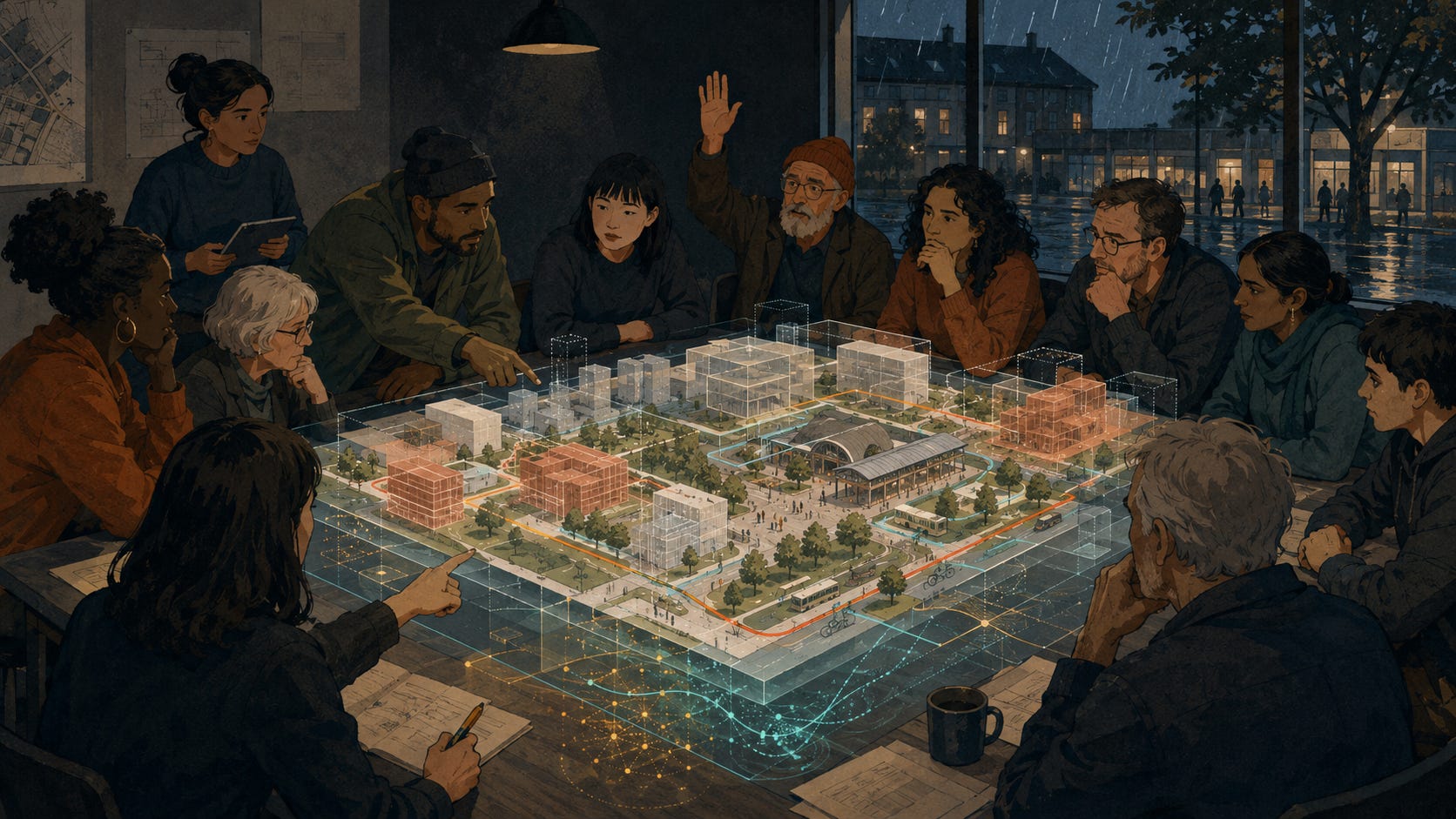
A participation lead opens the digital twin of a station area in a community centre on a wet Tuesday evening.
Forty residents sit in the room. Another thirty have joined online. The project team has brought three development options, all revised after the last steering group. The model shows the station square, the housing blocks, the schoolyard, the mobility hub, the public courtyard that has become contentious, and the phasing dependency that makes everyone in the project team slightly uneasy.
A resident asks what happens if the parking ratio is lowered further.
The mobility layer updates. The financial layer shifts. The model shows less underground parking, more room for trees, a small improvement in affordability, and a new dependency on the mobility hub opening earlier than currently funded.
Another resident asks whether the courtyard could be enlarged without losing affordable homes.
The system runs through the available options. It shows that this is possible in one variant, but only by moving volume toward the schoolyard and accepting more winter shadow. The AI assistant turns the output into plain language, with the uncertainty clearly marked. A planner adds that one of the assumptions is contested and will need separate verification.
For a moment, the meeting feels different.
Not because everyone agrees. They do not. Not because the model resolves the trade off. It does not. But the questions are reaching the decision space while it is still open. Residents are not only reacting to a finished proposal. They are testing the structure of the choice.
Then someone at the back raises a hand.
“Which of these things can still actually change?”
The room goes quiet.
That question is the whole article.
This scene describes what AI enabled participation can look like when the process is well designed, the project team is honest, and the option space is still genuinely open. Most processes are not like that. The tools are real; the conditions are not guaranteed. The decisive issue is not whether the technology works. It is whether the organisation is willing to let participation alter the work.
AI cannot create that willingness. But where the willingness exists, it can change the old economics of participation: more explanation, more follow-up, more iterative reasoning, at a depth that was previously too labour-intensive to offer at scale.
The previous piece argued that the digital twin is becoming a shared governance workspace. It can bring options, numbers, commitments and spatial consequences into the same room. But a shared workspace is not automatically a democratic one. Who can enter it, what they are allowed to question, what counts as a valid contribution, and whether anything they say can still alter the path of the project: those questions belong to the organisation, not the tool.
AI can make participation broader, faster and more legible.
It can also make participation more convincing while leaving power exactly where it was.
Participation is where the whole argument is tested
The machine room made participation data processable. Project memory made commitments traceable. Options and numbers widened the decision space. The digital twin made that space shared and spatial. None of that makes participation influential. Only a political design choice does that.
If AI improves internal project work but leaves participation as a late stage reaction exercise, the operating system becomes more capable without becoming more legitimate. The organisation will see more, calculate more, remember more and simulate more, while citizens still enter after the meaningful choices have narrowed.
That is not a minor omission. It would reproduce an old planning failure with better tools.
Sherry Arnstein’s critique from 1969 still matters because it names the issue directly. Participation is not defined by the number of people in the room, the quality of the visuals or the existence of a consultation portal. It is defined by power. Who can shape the decision, who can only respond to it, and who is present mainly to validate a process that has already moved on.[1] A working definition follows from that, though it is a normative one rather than a logical necessity: participation is meaningful when public input can change the decision before the decision is made, and when that change is traceable afterward. Arnstein’s framework addresses redistribution; recent scholarship extends it by adding recognition and representation as equally necessary conditions: whose knowledge is treated as valid, and who bears the consequences of choices made.[2]
AI does not make that question obsolete.
It makes it harder to avoid.
AI cannot create willingness
There is an uncomfortable observation underneath this article, and it is better to state it early than to imply it throughout.
Most participation does not fail because the tools are bad. It fails because serious influence is organisationally inconvenient and politically risky. An open option space slows projects down. Real influence can threaten financial feasibility. A developer wants to reduce risk, not distribute it. An elected official does not want to revisit a decision that was politically difficult to reach. An administrative organisation does not want a participation memory that later reveals which warnings were ignored.
Many organisations say they want better participation. What they often want is better acceptance. AI will not close that gap. It may make it harder to hide.
This distinction matters because AI will almost certainly be adopted in participation first as an efficiency tool: faster summaries, automated FAQ responses, cleaner reports. That is the natural path of least organisational resistance, and it is not wrong in itself. But an organisation that uses AI to handle participation faster has not automatically used it to make participation more influential. The default path leads to a more efficient consultation machine with roughly unchanged power relations.
The question is whether organisations choose to go further.
It is also worth naming a related problem. Not every planning process is or should be participatory in the full sense. Where a fundamental choice is already legally or politically fixed, the honest role of a process is explanation and local adaptation, not co-decision. Where the core decision is fixed, the duty does not disappear. It changes: from shared choice to honest explanation, accountable mitigation and genuine local refinement. That is sometimes legitimate. The problem is not that such processes exist. The problem is when they are labelled participation, complete with digital twins and AI assistants, while the core decision is no longer available for public input. Calling that participation is not a design error. It is a political choice.
The old participation problem was not only exclusion
Urban professionals often describe the weakness of participation as a problem of reach.
The same people come to evening meetings. Written consultations attract the highly motivated. Digital platforms bring in more responses but not necessarily a more representative public. People with less time, less confidence, lower literacy, language barriers or distrust of institutions remain underrepresented. Those are real problems.
But there is a second problem, and it receives less attention.
Planning organisations often do not know what to do with participation once they have it.
Hundreds of written responses arrive. Meeting notes pile up. Workshop post-its are photographed and stored. Online comments are exported into spreadsheets. The formal report appears weeks later, often organised into themes that are accurate enough and politically unusable. “Traffic”, “green space”, “safety”, “housing mix”, “identity of the area”. Everything has been heard. Little has been made sharper.
The deeper tension disappears in the act of summary.
Was the traffic concern about congestion, child safety, construction nuisance or distrust that mobility promises will be dropped later? Was the concern about green space mainly ecological, recreational, aesthetic, or a proxy for fear of losing a familiar place? Was the objection to density an objection to height, to social change, to pressure on services, or to the sense that the conclusion had been reached before the meeting began?
Participation data is not self-interpreting. It carries conflict, history, tone and strategic behaviour. It also carries weak signals that matter precisely because they are not the dominant theme.
This is where AI can help immediately. It can process large amounts of input, cluster recurring issues, compare consultation rounds, surface contradictions, map concerns geographically, produce first summaries in plain language and support translation across languages. OECD’s 2025 work on AI in civic participation identifies precisely these functions: processing citizen input, reducing implementation costs, improving access to information and lowering language barriers. A 2025 Delphi study among Finnish planners found especially strong agreement around AI’s usefulness for analysing participatory data.[3][4]
That matters. A participation advisor who spends less time coding responses manually has more time to interpret what those responses mean, check whether minority positions are being flattened and ask what the project should do with the signal.
The first gain, then, is not “automation of participation”.
It is more professional attention for the part of participation that cannot be automated.
AI can widen the entrance, and lower the cost of going deeper
Serious participation is expensive. Not because listening is inefficient, but because explanation, follow-up and interpretation all require time. A participation advisor can facilitate one good conversation, but cannot have five hundred of them. Informational evenings are time-bounded. Project websites are formally public and practically inaccessible. The result is that most participation formats are designed around what is affordable, not around what actually produces the best public knowledge.
That is the real structural constraint. It is, in the language of Article 2, a coordination cost problem: the cost of deep explanation, follow-up and interpretation is high enough that organisations routinely choose shallower formats instead. AI changes that cost structure. And that is more fundamental than document legibility.
It can offer layered explanations: a short version for orientation, a deeper version for those who want detail, a source-linked version for those who want to verify. It can turn technical plan language into questions residents can actually judge. It can help people understand the consequences of their own preferences before they commit to them.
That last point matters more than it might appear. AI can help residents move from reaction to reasoning. Not by telling them what to think, but by creating conditions in which they can think further: what lies behind this preference? What trade off does it require? What would I accept if this turns out to be impossible?
At its best, this does more than make government documents readable. It gives residents a patient first interlocutor. One that can explain the plan, answer follow-up questions, ask what matters underneath a first objection, and help turn an inchoate concern into a contribution that the planning process can actually work with. That kind of exchange was previously only possible at scale if you had a very large facilitation team. AI changes that constraint without replacing what the facilitator does in the room.
Consider a resident who works evening shifts. She will not attend the Tuesday meeting. But at 23:40, on her phone, she can ask what the plan means for the playground behind her block, why the parking street is being moved, and whether the green route shown in the visualisation is funded or merely indicative. She can be asked what matters most in her objection, and receive a response that helps her turn a concern into a usable contribution. That is a different threshold of access than a PDF and an evening in a community centre.
None of that replaces human facilitation. It extends the reach of good facilitation to more people, more questions, more moments in the project timeline.
The same is true for scenario exploration. Many planning questions are hard to engage with because they are presented as settled packages. One plan, one map, one response form. A digital twin linked to an AI assistant can expose the moving parts: if density rises here, what changes elsewhere? If more homes are made affordable, what financial assumption shifts? If public space increases, what programme or phasing consequence follows?
A 2025 systematic review of citizen-centred digital twins in land use agenda setting found that such tools can help residents frame problems, convince others and propose alternatives, provided the systems are understandable, interactive, inclusive and privacy oriented.[5]
The value is not that residents can rotate a model. The value is that they can enter the logic of the decision early enough to contest it. That is a different kind of access than a PDF and a Tuesday evening meeting. It is also the condition that makes the next question unavoidable: whether the option space was still open when they arrived.
The option space must be open at the moment of participation
The polished version of AI enabled participation looks compelling.
Residents test variants on a model. The process feels active. The municipality can document meaningful public access. Everyone leaves with the impression that planning has become more responsive.
But there is one prior question.
Was the option space still open?
If the financially and politically viable range had already been fixed before the session, the model may allow interaction without allowing influence. People can move trees, widen a pavement and discuss roof gardens while the housing mix, phasing logic and public space footprint are no longer genuinely in play. They are participating in surface variation around a closed core.
That is not a technology failure. It is a process design choice.
This is where the previous article’s distinction matters: not possible, not chosen and not funded. Participation becomes poisonous when those three are blurred. Residents ask why something cannot happen. The organisation answers with the authority of necessity, even where the real answer is that it was not chosen, or not chosen under current budget assumptions, or not chosen because another public goal was prioritised.
AI can help separate those categories. It can show which constraints are legal, which are physical, which are financial, and which are project-specific assumptions that could be revisited. Doing so requires care: AI can identify distinctions in text, but whether something is genuinely political rather than genuinely impossible requires institutional knowledge that the system does not have. The organisation must do that analytical work first. AI can then help make it visible.
But only if the organisation wants that visibility.
There is also an asymmetry worth naming. Organisations and developers can use AI to optimise scenarios, pre-empt objections and sharpen their own argumentation at a speed and scale that was not previously affordable. Residents, in most current processes, receive a chatbot. That is not a neutral distribution. If AI sharpens the capacity of project teams faster than it improves the reasoning capacity of participants, it may widen the power gap it was supposed to help close. And not everyone can navigate a 3D model on a borrowed phone: the digital twin as shared workspace only functions as such if the interface is genuinely accessible, not merely technically available. The tools are not inherently democratising. The design choices are.
A digital twin without an open option space is a theatre set. AI makes the lighting better.
Synthesis is where power hides
AI is often presented as a neutral summariser of public input.
It is not.
Any summary makes choices. It decides what counts as a theme, what gets grouped together, what is treated as repetition, what is labelled as an outlier and what disappears because it does not fit the dominant categories. Human analysts do this too. The difference is that AI can do it at a scale and speed that makes the politics of compression less visible.
A 2025 study on AI in participatory urban planning warns that analytical systems can make parts of the population invisible and that generative systems raise deeper questions about which public is being represented in a process.[4] That concern should be read as a design requirement, not as a reason to avoid the tools altogether.
It also connects to a risk identified in Article 3. The machine room argued that the easier it becomes to produce fluent-looking output, the easier it becomes to confuse fluency with reliability. In the participation context, that risk carries a democratic weight. A participation advisor who accepts a smooth AI synthesis without checking the underlying clustering has not only made a quality error. They have made a political one: minority voices disappear not through deliberate suppression but through professional convenience.
Participation synthesis in the AI era should therefore be inspectable. That is not a feature AI provides automatically. Most large language models are less transparent about their clustering logic than a careful human analyst with a visible coding scheme. Inspectability is a design requirement: the raw input must be stored and accessible; the theme labels must be documented with enough reasoning to be challenged; minority positions must be surfaced through an explicit protocol before the synthesis is accepted as the official account; and a human must sign off on the result before it leaves the organisation. None of that is technically difficult. All of it requires deliberate process design.
There is a further complication. The operational machine room thrives on clean, interoperable data. Participation data is inherently narrative, emotional and messy. Forcing it into rigid parameters before synthesis happens is not data purification. It is political sanitisation.
This is also where quantitative instincts can mislead. Frequency matters. It does not settle significance. A concern raised by three people may be marginal. It may also identify a future failure that the majority cannot yet see. A single disability access concern can reveal a design blind spot. A small group’s distrust can indicate a long project history that newer staff do not know. A recurring irritation expressed in restrained language can matter more than a louder objection that has little bearing on the final decision.
Good participation analysis does not confuse prevalence with importance.
AI can help reveal both. It should not be allowed to collapse one into the other.
From consultation to iterative reasoning
The deepest change AI makes possible in participation is not that it collects more input. It is that it can make participation iterative.
Conventional participation is mostly one-directional. A resident states a preference. The project team notes it. The formal report places it in a category. The process moves on. The resident rarely discovers what happened to what they said, or what would change if they had said something different.
AI, linked to a shared scenario environment, can work differently. A resident who says “the courtyard should be larger” can be asked: why does that matter to you? What are you worried would happen without it? If making it larger means accepting a different building height elsewhere, is that a trade off you could accept? What if the enlarged courtyard comes with a reduced green buffer on the other side?
Those questions do not manipulate. They deepen. They help people move from a position to a reasoning, from a preference to an interest, from a reaction to a considered judgement. It is not a formal Delphi method. But it draws on a similar logic: iterative clarification, structured reflection, and the possibility of revising a judgement in light of consequences the participant had not yet seen.
This is not a description of AI as autonomous facilitator. The AI penalty section later in this article documents a real finding: people are less willing to join deliberative processes when they know AI is running them. The iterative model only works if AI operates as an instrument under human direction, not as the face of the process. A human facilitator leads the session. The AI deepens the background work: it runs the follow-up, tracks what has been said, shows the trade off consequences, feeds the summary back for human review. The resident experiences a richer conversation. They do not necessarily experience a machine.
That is not a trivial shift. Most planning processes never reach it, not because residents are incapable of it, but because the cost of facilitation at that depth makes it impractical at scale. AI changes that cost structure.
But the shadow of this possibility must be named immediately. More depth in the conversation is not automatically more influence in the decision. An AI that asks good follow-up questions, listens carefully and produces a sophisticated synthesis can still be embedded in a process where none of that input reaches the decision. The iterative layer can become the most sophisticated form of participation theatre yet invented: residents feel genuinely heard, reflect carefully, receive nuanced responses, and change nothing.
The test is not whether the conversation deepened. It is whether the decision changed.
That check must be external to the AI system. It must be institutional.
Participation is not just input. It must enter the memory.
A participation process usually leaves behind two records.
The first is the formal report. It says how many people attended, how many comments were received and which themes emerged.
The second is the actual memory of the process. That record is messier and more valuable. It includes which residents felt that a promise was made. Which subject kept returning despite never ranking highly by volume. Which objection was technically answered but relationally unresolved. Which group had a different reading of the place than the official project team. Which answer created relief and which answer deepened distrust.
The project memory room from Article 4 should hold this second record.
That does not mean storing every raw emotional response forever. It means preserving the parts of participation that remain relevant for future decisions: commitments, unresolved tensions, minority positions, contested assumptions, accepted trade offs and rejected alternatives. If the project later changes direction, the organisation should be able to see what participation had already made visible and whether that knowledge was honoured, revised or quietly dropped.
AI can help build that record. It can compare participation rounds, trace when a concern first appeared, detect whether a promise made in one phase has disappeared from later documents, and draft a transparent change log: this concern was raised, this assumption was tested, this element changed, this element did not change, and this is why.
That is a different model from “you said, we did”.
Many organisations use that phrase, or some version of it, with good intentions. But urban development is rarely so direct. A resident says one thing, several interests interact, a decision shifts partly, a later constraint reopens the question. A better format would be:
Not "you said, we did." Something harder: what we heard, what we did with it, what changed and what did not, and why. And what remains open.
That last item matters most. A process that has no unresolved questions has not been honest. It has been managed.
Visualisation helps people speak. It can also over-persuade.
Generative images are beginning to appear in participatory planning. Their appeal is obvious. Many residents struggle to respond to abstract plan language, but they can react immediately to an image of a greener street, a widened pavement or a redeveloped square. Images can unlock conversations that technical drawings do not.
A 2025 study in Landscape and Urban Planning explored generative AI images in community participation and proposed a useful middle ground: “controlled imperfect” images. Not polished pseudo-final renderings that imply false certainty, and not rough outputs so vague that they block discussion. Images should be concrete enough to provoke response, but open enough to invite correction.[6]
That principle travels well beyond landscape planning.
Participation images should not make a future look decided before it is. A visually compelling AI-generated streetscape can quietly privilege one option, make trade offs disappear and pull discussion toward aesthetic approval rather than substantive choice. The more beautiful the image, the more disciplined the process around it needs to be.
What assumption does this image contain? What is missing from it? What would change if the budget, density or management model changed? Is this showing an option, or selling one?
Visual participation becomes valuable when images are treated as thinking instruments.
It becomes dangerous when they become soft persuasion.
The AI penalty is real
There is another risk that pro-AI participation advocates tend to understate.
People may not want AI in the room.
A 2025 preregistered survey experiment with a representative German sample found that people were less willing to join deliberative processes when they were told AI would facilitate them, and expected those processes to be of lower quality than human-led formats. The authors call this an “AI penalty” and warn that it could create a new deliberative divide, based not on education or income, but on attitudes toward AI.[7]
The penalty compounds when institutional trust is already low. Research on trust in AI-assisted government consistently finds that confidence in the technology is not independent of confidence in the institution using it: trust in high-risk AI systems is a function not only of the technology’s features but also of trust in the institutions under which they operate.[9] In neighbourhoods where the municipality has a history of broken commitments or top-down decisions, AI in the participation room may read as another layer of managed distance. Not as a tool for residents, but as a tool for managing them more efficiently.
That finding should not be overgeneralised. A virtual focus group study published the same year found that disclosed AI summaries were positively received by participants, especially when transparency was clear. Participants also expressed concern that AI might miss emotion and nuance in sensitive discussions.[8]
AI may be widely accepted as a support tool behind the process: translation, first summaries, source retrieval, question handling, comparison of consultation rounds. It may be more contested when it acts as moderator, facilitator or simulated conversational partner. A technical housing workshop is not the same as a painful redevelopment process in a neighbourhood with a history of distrust.
The organisational error would be to assume acceptance because the tool works.
Participation depends on legitimacy as much as functionality.
Simulated publics are useful only when they remain simulated
Generative AI can simulate stakeholder positions, likely objections and possible deliberative dynamics. That is tempting for planning teams.
Before a meeting, a project team could ask a model to test how different residents, entrepreneurs, housing advocates and accessibility groups might respond to a proposed scenario. It could surface weak arguments, missing questions and possible conflict points. A 2026 article in the Journal of Deliberative Democracy argues that generative AI simulations may complement human deliberation by helping train facilitators and providing rapid exploratory consultation under time pressure.[10]
Used that way, simulation can sharpen preparation.
But it cannot substitute for public participation.
A simulated resident has no standing. A generated objection has no lived stake. A model can predict a concern without being harmed by the decision. It can rehearse politics. It cannot embody it.
This boundary must remain firm, especially because the technology will make simulated publics sound persuasive. Planning organisations under time pressure may be tempted to use generated stakeholder views as a shortcut, particularly in early stage work when no formal participation is yet required. That is precisely where caution is needed. Early stage framing shapes the option space. If simulated publics are used to close options before real publics enter, participation has been displaced at the point where it matters most.
Simulated participation can help prepare for real participation. Where it replaces real participation, the organisation has not saved time. It has produced a decision without a public, and called it consulted.
What meaningful AI supported participation would look like
The practical question is not whether AI appears somewhere in the participation process. It is whether participation becomes more influential, more traceable and harder to misrepresent.
By that point, the standard becomes quite concrete. Not impressive technology. Six disciplines.
First, participation should begin before the core option space has closed. If a project team can only explain, not change, that should be said plainly.
Second, the process should distinguish fixed constraints from open choices. Legal impossibility, financial pressure, political preference and project habit are not the same category.
Third, AI assisted synthesis should be reviewable. Raw input, coding choices, summary logic and minority positions should not vanish behind a clean report.
Fourth, participation should feed the project memory. Commitments, contested assumptions, unresolved tensions and reasons for rejecting proposals should remain queryable later.
Fifth, visual and conversational AI should be treated as instruments for exploration, not tools of persuasion. Their outputs should show uncertainty and invite correction.
Sixth, the role of AI should be disclosed in language people understand. Not through a generic privacy paragraph, but through a clear account of what the system does, what it does not do and where human judgement remains responsible.
These criteria are only useful if they become auditable commitments: not internal guidelines, but standards against which a participation process can be assessed after the fact. Without an enforcement mechanism, the list describes intentions. Planning organisations that take AI seriously will make the criteria public before the process begins, and account for them afterward.
Where to start
Most planning organisations should not begin with an ambitious civic digital twin and an AI facilitator in every workshop. That is too large a leap and, in many cases, a solution in search of a process.
Start smaller.
Choose one live project with a real but manageable participation stream. Use AI to structure written responses, but keep the analysis reviewable: store the raw input, document the clustering choices, flag the minority positions explicitly before finalising the summary. That last step takes ten minutes. It is the difference between a synthesis and an official account. Produce a participation log that separates themes, minority positions, commitments, open questions and decisions. Compare the result with the traditional summary and ask which one better supports an honest project conversation.
In a second step, connect that participation log to the project memory. When a new option is developed, make visible which earlier concerns or commitments it touches. When an option is rejected, record why.
Only after that does it make sense to bring participation into a shared scenario environment. By then the organisation has learned the harder discipline: not how to make people interact with a model, but how to make public input alter the work in a traceable way.
The temptation will be to begin with the impressive layer.
The wiser route is to begin with the accountable one.
What this changes
Return to the community centre.
The resident at the back has asked the essential question: “Which of these things can still actually change?”
A weak process gives a reassuring answer. “We are here to listen.” That may be true, but it avoids the point.
A stronger process answers concretely.
The housing target is fixed by a council decision. The exact block distribution is not. The affordability commitment remains in place, but the risk allocation is under review. The mobility hub is not funded yet, which means any option that depends on it carries an unresolved condition. The courtyard can be enlarged, but not without consequences elsewhere. The public space quality standard is open to refinement. The phasing sequence is still under discussion. These three issues raised tonight will be tested against the model and added to the project memory. The team will show what changed, what did not and why.
That answer does not manufacture agreement.
It creates a more honest conflict.
That is the promise of participation in the AI era. Not harmony. Not instant consensus. Not a frictionless interface between citizens and government.
A better decision room.
One in which public knowledge enters earlier, is developed more carefully, stays visible longer and changes the options before the options become fate.
Next in this series: Five levels. AI use in urban practice is not a binary question. The next article maps the maturity ladder from individual assistance to a genuinely reconfigured planning organisation.
Yes, I used AI. Here’s how.
Yes, I used AI. It helped with source finding, source comparison, structure, critical review and drafting alternatives. I used it as a sparring partner, not as an authority. The argument, source selection and final wording are my own.
Notes
[1] Sherry R. Arnstein (1969). A Ladder of Citizen Participation. Journal of the American Institute of Planners, 35(4), 216 to 224. Arnstein’s core claim: participation is meaningful only to the extent that it redistributes influence over decisions. She also identifies the structural obstacles: on the side of powerholders, resistance to redistribution; on the side of residents, weak political infrastructure and distrust built from accumulated futility.
[2] Revisiting Arnstein’s framework through Nancy Fraser’s tripartite model of justice, JAPA (2019) extends the conditions for genuine participation to include recognition (whose knowledge counts as valid) and representation (who bears the consequences of decisions). The three dimensions, redistribution, recognition and representation, each point to a different place where AI can either strengthen or undermine participation.
[3] OECD (2025). AI in civic participation and open government, in Governing with Artificial Intelligence. The chapter identifies practical uses of AI for participation, including processing citizen input, reducing costs, widening access and lowering language barriers, while stressing the need for skills, testing and evaluation.
[4] Carina M. Raymond et al. (2025). Uses, opportunities and risks of artificial intelligence in participatory urban planning. Discover Cities. Based on a Delphi study with Finnish planners, the paper maps opportunities and risks across analytical, generative and humanised AI. Particularly useful on participation data analysis, risks of population invisibility and the danger of synthetic public positions distorting participatory processes.
[5] David Adade and Walter Timo de Vries (2025). A systematic review of digital twins’ potential for citizen participation and influence in land use agenda setting. Discover Sustainability, 6, article 354. The review finds that citizen-centred digital twins can strengthen agenda setting and proposal formation, but only when they are accessible, interactive, privacy oriented and institutionally connected to decision making.
[6] Ishraq Awashra et al. (2025). Generative AI text to image for community participation in landscape planning. Landscape and Urban Planning, 264, 105464. The paper’s “controlled imperfect” principle: visual outputs should be specific enough to support discussion, but not so polished that they prematurely imply a settled future.
[7] Andreas Jungherr and Adrian Rauchfleisch (2025). Artificial Intelligence in deliberation: The AI penalty and the emergence of a new deliberative divide. Government Information Quarterly. In a preregistered survey experiment with a representative German sample, respondents showed lower willingness to participate in AI facilitated deliberation and lower expectations of process quality.
[8] Ye Wang et al. (2025). Trusting the machine: Exploring participant perceptions of AI driven summaries in virtual focus groups with and without human oversight. Computers in Human Behavior: Artificial Humans, 6, 100198. Disclosed AI summarisation can be accepted by participants, while raising concerns about accuracy, authenticity and the loss of emotional nuance.
[9] Araz Taeihagh et al. (2025). Conceptualising public trust in high-risk AI policymaking: A comparative analysis of three Asian cities. Public Management Review. Trust in high-risk AI systems is a function not only of the technology’s features but also of trust in the institutions under which they operate. Significant differences in institutional trust patterns directly affect AI acceptance across contexts.
[10] Joshua Rountree and John Gastil (2026). The Case for Using Generative AI to Run Deliberation Simulations. Journal of Deliberative Democracy, 1(1). Generative AI simulations may complement human deliberation as a preparation tool, while the authors warn against bias, privacy loss and any substitution of simulated for real public deliberation.