
The question behind the tools
When the model performs well and the institution still fails

This is Article 9 in a nine part series: The Urban Professional in the Age of AI, based on The Urban Operating System.
1. The gap · 2. Three paradigms · 3. The machine room · 4. Project memory · 5. Options and numbers · 6. The digital twin · 7. Participation · 8. Five levels · 9. The question behind the tools ← you are here
The station area model is ready.
The project team has done the work. The project memory room is connected. The commitment register is live. The assumption register has been updated after the latest cost review. The participation synthesis is visible, including the minority positions that would once have disappeared into a summary paragraph. The digital twin can run scenarios across massing, mobility, public space, phasing and finance in the same environment.
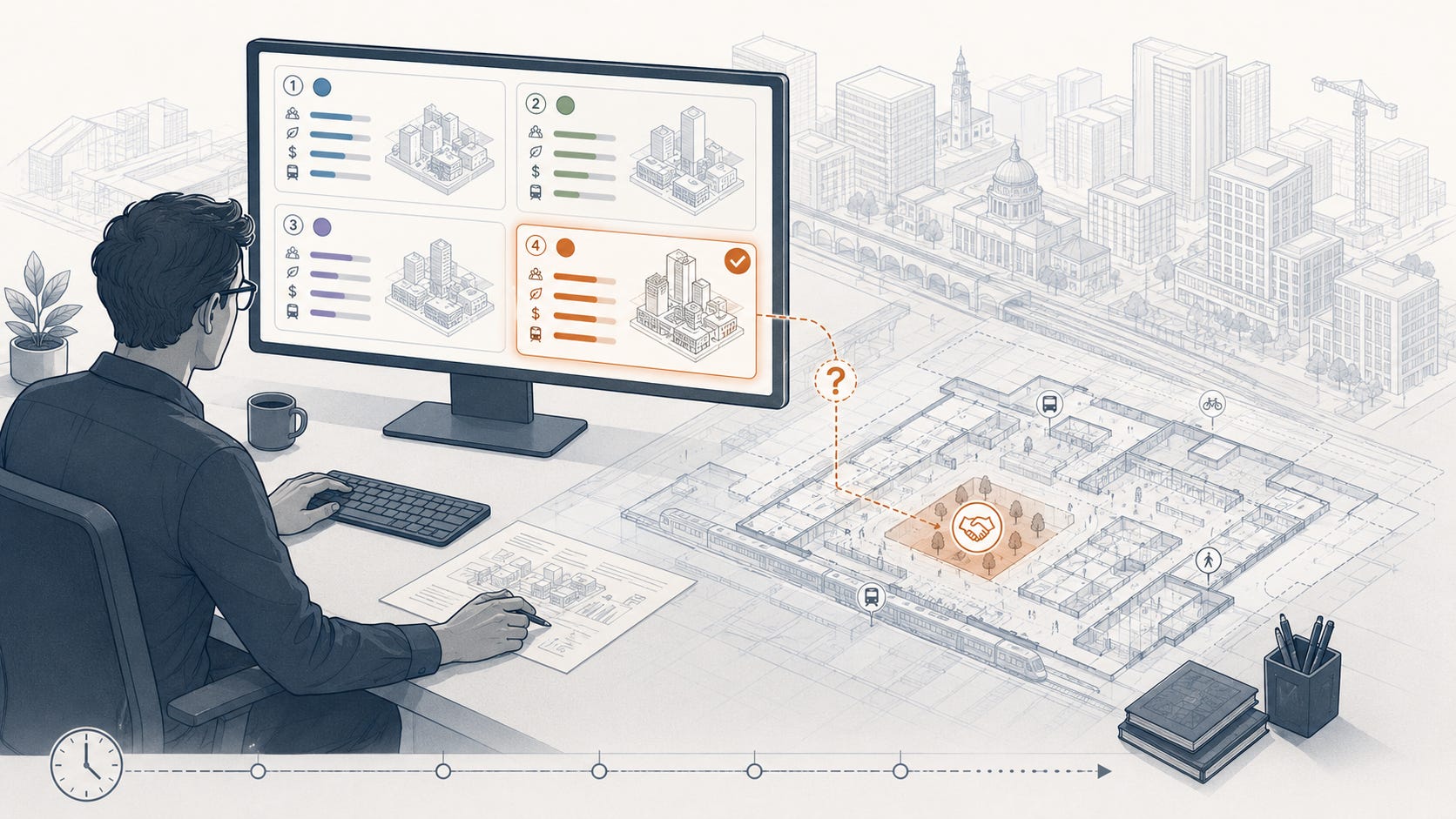
The AI assistant has prepared four options for the steering group.
Option A delivers the housing target fastest, but weakens the public space promise made in 2024.
Option B protects the courtyard and the route to the school, but requires a larger public investment earlier than the current capital plan allows.
Option C keeps the affordability promise, but depends on the mobility hub opening before the first phase is occupied.
Option D is technically elegant. It balances the model better than the others. Lower infrastructure exposure. Smoother phasing. Stronger residual value. A credible public story.
Then the project director notices what the model has done.
Option D only works because the system has treated a long-standing promise as adjustable. Not legally fixed. Not contractually hard. A commitment made in participation, recorded in the project memory room, but not protected in the optimisation logic.
A colleague could already frame the defence: the promise was recorded, but never formally converted into a binding condition. It was made under the previous programme, before the cost review changed the parameters. The council never formally adopted it. Technically, there is room.
No rule has been broken. No error has occurred. The tool has done exactly what it was asked to do.
That is the problem.
The project director looks at the screen and understands that the final question was never about AI.
It was about what the organisation had told AI to value.
The central question of AI in planning is not whether the tools can support urban professionals. They can. The question is whether planning institutions can name what must not be optimised away before the model runs. The real risk is not that AI makes the wrong choice. The real risk is that it makes an institution’s hidden choice easier to defend.
Across this series, the argument has moved from capacity to consequence. AI can do more of the analytical work of planning than most teams are currently using it for. But each gain moves the decisive question one step earlier: what has the institution instructed the system to value? The machine room showed where friction can be removed. Project memory showed what disappears when it is not. Options and numbers showed how politics moves upstream into weights and thresholds. The digital twin showed that a model of the city is also an argument about it. Participation showed that wider access does not guarantee influence. Five levels showed that every delegation of task is also a transfer of burden.
This final article starts where that argument ends.1
What is the city for, and who gets to decide?
AI does not answer the planning question. It accelerates the answer already present.
There is a tempting version of the AI story in urban planning. Better tools will make planning faster. Better models will make trade-offs clearer. Better governance frameworks will make all of this safer.
Much of that is true. It is also incomplete.
AI does not arrive in a neutral institution. It enters organisations with existing incentives, blind spots, political pressures and habits of avoidance.2 Where the institutional logic is sound, it compounds good judgement. Where it is weak, it compounds avoidance. A municipality that treats housing delivery as the only real target will use AI to accelerate delivery. A development process that treats participation as risk management will use AI to manage that risk more efficiently.
There are counterexamples. In some organisations, AI implementation has forced a degree of explicitness that improved processes which had been informal and poorly managed: when a team must specify what the model should optimise, they sometimes discover no one had agreed on that before. But that outcome requires institutional leadership willing to use implementation as an opportunity rather than a shortcut.
A model can optimise housing numbers and miss housing need. It can optimise participation volume and miss whether participation changed anything. It can optimise delivery speed and miss the long-term cost of distrust.
The mistake is not using AI. The mistake is thinking that better calculation settles the question of what should count. That question has to be asked before the tool enters the room.
The prompt that matters is not in the window
Urban professionals spend a lot of time learning how to prompt AI systems. That is useful. But it is not enough.
The more important prompt is the one the institution gives, usually without writing it down.
Maximise delivery. Minimise risk. Avoid political exposure. Protect land value. Keep the process moving. Make the proposal defensible. Reduce conflict before the council meeting.
None of these instructions needs to appear in a prompt window. They live in templates, performance indicators, budget cycles, legal advice and meeting habits. They shape what the model is asked to do and what its output will be used to justify.
There is a second source of institutional prompts the field is slower to name: the platform. When a municipality adopts a commercial planning tool, the model settings, dashboard defaults and optimisation weights are not neutral. They carry product logic. The institutional prompt may not come from the organisation at all. It may arrive pre-installed.
The question this raises is not only whether the system follows instructions. It is whether the instructions are legitimate.
A planning model can be perfectly aligned with an illegitimate goal. It can faithfully optimise for land revenue while suppressing affordability. It can faithfully reduce complaint volume by steering participation toward questions that cannot affect the project. It can faithfully produce a legally defensible answer that no resident recognises as honest.
Cugurullo and Xu (2025) call this the oracle problem: AI systems in urban governance that generate authoritative-looking outputs without exposing the value assumptions built into them.3 The oracle does not need to lie. It selects. And the selection happens before the steering group meets.
The APA Foresight Trend Report 2026 points to a governance reframe already underway: the question has shifted from “can this work technically?” to “under what rules, with what oversight, for what public purpose, and with what protection of rights?”4 That shift locates the governance problem not in the algorithm, but in the institution operating it.
A public planning institution cannot treat public purpose as an internal preference. It works with democratic mandates, legal rights, distributional consequences and places people cannot simply leave.
The city is not a client brief. It is a shared condition.
That is why alignment in planning is political before it is technical. There is no model that can rank competing public values once and for all. Housing delivery matters, and so does who can actually afford to live in what gets built. Climate adaptation matters, and so does whether children can still move freely through the neighbourhood. Public trust matters, and so does the right of existing residents not to be treated as an obstacle to a future drawn without them.
That is why the professional role does not disappear. It changes. The planner becomes less a producer of all analysis and more the person who ensures the questions, assumptions and value choices behind the analysis can be inspected, contested and defended.
The counterargument deserves a harder hearing
There is a serious objection to this whole line of argument. And it is sharper than it first appears.
The capacity version is familiar. Many planning organisations are overloaded. Housing targets are urgent. Staff are tired. Residents receive poor explanations not because anyone wants to exclude them, but because teams do not have enough time. If AI can reduce administrative overload and help smaller municipalities access expertise they cannot hire, then using it is not a threat to planning values. It is a way to protect them.
The structural version cuts deeper. When a team must specify what the model should optimise, they sometimes discover that no one had agreed on that before. That forced articulation does not always deepen existing patterns. Sometimes it interrupts them.
But there is a third version that deserves to be taken seriously. The profession may be over-romanticising judgement. Many planning processes already hide weak reasoning, selective listening and political avoidance. AI may not corrupt planning. It may reveal that parts of it were never as deliberative as the profession liked to believe.
That critique lands.
The answer is not that AI makes these problems worse by default. The answer is that AI makes them faster, harder to see and more difficult to contest. Slow, manual planning at least created friction. Sometimes that friction was the only moment the wrong answer could be questioned.
Capacity without direction is not public value. It is faster drift. The question is what the institution spends that capacity on, and who inside the institution has the standing to ask that question before the model runs.
The city as optimisation problem
A city can be described as an optimisation problem. Land is scarce, public money is scarce, political attention is scarce. Every plan allocates scarcity, and every allocation creates winners, losers and future constraints. Optimisation has a place here. A planning organisation that refuses it because it sounds technocratic will make worse decisions.
But the city is not only an optimisation problem.
It is also a place where people form attachments, remember promises, avoid certain streets, claim dignity, grow old and disagree about what matters. Some of these things can be measured, some can only be named, and some only appear when the process has made room for them.
The danger is not that optimisation enters planning. It already has.5 The danger is that optimisation becomes the grammar through which all other values must speak.
A tree matters because it reduces heat. A courtyard matters because it raises social interaction metrics. A quiet corner matters because the public health literature supports it. Those arguments may be useful. But something is lost when every urban value needs an instrumental justification before it can enter the model. Some values need to be named as values.
Public value must be made operational, but not reduced
This is the hardest practical challenge.
A value that is never operationalised will lose every time it meets a cost estimate or a legal deadline. Affordability becomes a rounding error. Trust disappears from the model entirely. But the moment values become operational, they risk being reduced: affordability to a percentage, dignity to an accessibility score, spatial quality to a checklist.
Each translation is useful. Each is incomplete. The work of governance is to keep both truths visible at the same time, which means every public value that enters an AI-assisted workflow needs two records: the measurable proxy and the reason the proxy is not enough. Someone must own that difference, or the proxy will quietly become the policy.
Take affordable housing. A model can track tenure mix, rent levels and eligibility categories. That is necessary. But the public question is wider: who can actually live here, under what security, with what access to schools and care? A technically compliant affordability score may still fail the urban question.
Take public space. A twin can calculate square metres, heat reduction and walking distances. Good. But it may still miss whether a space invites staying, whether teenage girls feel welcome, whether older residents can sit without buying anything, whether the place carries memory.
The professional question changes
The old professional question was: what is the right plan? The communicative question added: who must be heard before a plan can claim legitimacy? The algorithmic question now adds: what has the system been instructed to see, optimise, ignore and remember?
Urban professionals do not need to become machine learning engineers. But they do need to know when a model is being used beyond its proper boundary, where the source base is thin, and which choices should not be delegated even when they can be formalised.
This rests on an assumption worth naming: that the professional has the institutional standing to exercise that judgement. In practice, the tool may be procured elsewhere, configured by a vendor and introduced under pressure. The planner may not be shaping the system. They may be operating inside it. Many organisations will want exactly that: someone who reviews outputs within parameters set elsewhere, who signs off without reopening the weights, who keeps the process moving without questioning what the model was told to maximise.
The profession’s task is not only to develop the competence. It is to argue for the standing. Without that standing, professional judgement becomes a review task inside someone else’s system.
The dominant promise of AI is speed. In many parts of planning, speed is welcome. But democratic planning also needs deliberate friction. Time to notice that a clean option depends on a broken promise. Time to let conflict surface before it becomes litigation, protest or quiet withdrawal.
A profession that cannot slow the tool down will eventually be governed by its pace.
The institution needs a doctrine of use
Most planning organisations will begin with use cases, not philosophy. That is understandable. But after the first pilots, something more formal is needed. Not a generic AI policy. A doctrine of use for public planning.
A doctrine can be stated in three rules. Before the model runs, name what it is not allowed to trade away. Before the output reaches a decision maker, name who carries the judgement. Before the capacity is freed, name where the attention goes.
Those three rules do not answer every case. They set the institutional habit.
On the first rule: every AI-assisted workflow requires a prior public value statement that names which commitments are hard constraints, not variables. In the station area case, that means naming the courtyard promise before the optimisation runs, not discovering its status afterwards. The EU AI Act establishes traceability and human oversight as legal baselines for high-risk applications;6 a doctrine of use makes those baselines operational in the specific context of urban planning.
On the second: AI may support analysis, generate options and surface patterns. It may not decide which public promise is negotiable. In practice, this means a named project leader, not “the AI workflow”, signs for each consequential judgement. Goldsmith and Yang (2026) argue that AI in urban governance redistributes discretion without always redistributing accountability.7 The doctrine closes that gap by making accountability visible before a decision, not auditable after.
On the third: the capacity freed by AI is not a surplus. If a participation synthesis that once took three weeks now takes three days, those days do not go to producing the next summary. They go to interpreting the minority positions that the synthesis flagged but did not resolve. The APA Foresight Trend Report 2026 points to a risk already visible across municipalities: AI-governance quality is uneven, which means citizen protection has started to depend on which city someone lives in.[3] Reinvesting freed attention is how a public institution refuses to let that divergence determine what counts as legitimate planning.
The strongest critique accepts the tools
The strongest critique of AI in urban planning is not that the tools are useless. That case is increasingly unconvincing.
The strongest critique is that the tools may become useful too quickly for the institutions around them to adapt. Weak processes start to look competent. Thin participation looks responsive. Contested priorities look technically balanced. Political choices become harder to see because they are embedded earlier, in cleaner systems, behind better interfaces.
That critique should not lead to refusal. Refusal will not protect public planning. It will only leave the transition to vendors, early adopters and overstretched organisations making practical decisions under pressure.
The better response is institutional seriousness. Use the tools, but with a theory of public value. Use them with records that can be inspected and professional formation designed into the workflow. Use them with enough scepticism to know when the output is fluent and wrong. A sociotechnical audit of six commercial LLMs in urban infrastructure decisions found that 51.3% of cited regulations, codes and technical sources were fabricated or unverifiable, and that model confidence correlated negatively with reasoning quality: the worst-performing models answered with the greatest certainty.8 Fluency is not competence. Use them with enough ambition to know when manual work is no longer defensible.
The future of the urban professional is not protected by staying outside the system. It is protected by shaping the system before it shapes the profession.
What this means on Monday morning
The lesson from Option D is not that every public promise must be preserved forever. Conditions change. Promises can be revised. But revision requires authority, explanation and memory. The model may identify the trade-off. It cannot decide whether the institution is allowed to make it.
That distinction is the operational version of the whole series.
Before using AI to draft a note, ask what the note must not flatten. Before summarising participation, ask whose position is most likely to disappear. Before generating options, ask which commitments are hard constraints and which are merely preferences. Before ranking scenarios, ask who approved the weights.
If the time saved is spent producing more output, the profession becomes faster. If it is spent checking assumptions, widening options, improving participation and confronting political choices earlier, the profession becomes better.
The difference will not be made by the model. It will be made by the institution around the model.
The urban operating system is not software
The phrase urban operating system can sound technical. It is not. An operating system is what determines what can run, what connects, what has priority, what is logged, what is hidden and what keeps working in the background when everything else is under pressure.
Every planning organisation already has one. It consists of laws and habits, templates and political routines, professional norms and the informal knowledge that never gets written down. AI does not replace that operating system. It runs on top of it. And when the operating system is weak, AI does not fix it. It exposes the weakness, scales it, or makes it harder to notice.
Some operating systems are built internally over decades of practice and law. Others are bought, licensed and updated by someone whose definition of a good planning process is not public. A municipality that procures a closed platform does not only buy a tool. It may be importing a set of optimisation assumptions it did not write, cannot inspect and may not be able to exit.
That is why this series has not been a tool guide. The tools will change. What will not change are the institutional questions.
What does the organisation remember, and what does it forget? Who can challenge the model? Who owns the judgement? Who benefits from speed, and who pays for error? What kind of city is being made easier to build?
These questions are not outside AI adoption. They are AI adoption.
Back to the station area
The project director rejects Option D.
Not because it is technically weak. It is technically strong.
She rejects it because the system has treated a public promise as a negotiable variable without asking whether the institution had the authority to do that.
The team reruns the model.
The new options are less elegant. More expensive. Harder to explain. One requires a political choice about the capital plan. One requires renegotiating the phasing with the developer. One requires the council to decide whether the housing target or the public space promise carries more weight under the changed financial conditions.
That is uncomfortable.
It is also the work.
For a moment, the AI system has done its best job. Not by producing the cleanest answer. By forcing the institution to see the choice it was about to hide from itself.
The question behind the tools was never whether AI can help urban professionals. It can.
The question is whether urban professionals, and the institutions they work in, can become clear enough about public purpose to govern what AI makes possible.
The city will not be shaped by AI alone. It will be shaped by the public values, evasions and compromises we allow AI to accelerate.
Yes, I used AI. Here’s how.
Yes, I used AI. It helped with source finding, structure, critical review and drafting alternatives. I used it as a sparring partner, not as an authority. The argument, source selection and final wording are my own.
Notes
The previous articles in this series. Especially Article 4 on project memory, Article 5 on options and numbers, Article 6 on the digital twin, Article 7 on participation and Article 8 on delegation levels. Used as the internal argument structure for this final piece.
UN-Habitat. 2022. Artificial Intelligence and Cities: Risks, Applications and Governance. https://unhabitat.org/ai-cities-risks-applications-and-governance. Used for the foundational observation that AI embeds value choices unconsciously unless institutions deliberately govern toward the public interest, and that optimisation can sideline justice, equity and lived experience.
Cugurullo, F. and Xu, Y. 2025. When AIs become oracles: generative artificial intelligence, anticipatory urban governance, and the future of cities. Policy and Society, 44(1), 98–115. https://doi.org/10.1093/polsoc/puae025. Used for the oracle problem: AI systems in urban governance that generate authoritative-looking outputs without exposing their underlying value assumptions.
American Planning Association. 2026. Foresight Trend Report for Planners. https://www.planning.org/publications/document/9283891/. Used for: the governance reframe from technical capability to rules, oversight and public purpose; and the observation that local AI-governance quality is already uneven across municipalities.
Sanchez, T.W., Brenman, M. and Ye, X. 2025. The Ethical Concerns of Artificial Intelligence in Urban Planning. Journal of the American Planning Association, 91(2), 294–307. https://doi.org/10.1080/01944363.2024.2355305. Used for the argument that bias, opacity and accountability gaps in AI planning tools are not hypothetical but already present in deployed systems.
European Union. Regulation EU 2024/1689, the Artificial Intelligence Act. https://eur-lex.europa.eu/legal-content/EN/TXT/?uri=CELEX:32024R1689. Used for the legal baseline on traceability, human oversight and risk management in high-risk AI applications, as context for the doctrine of use argument.
Goldsmith, S. and Yang, J. 2026. AI and the Transformation of Accountability and Discretion in Urban Governance. Urban Governance. https://doi.org/10.1016/j.ugj.2026.02.005. Used for the argument that AI redistributes discretion without automatically redistributing accountability.
Poudel, A., Barrios, C., De La Torre, P. and Silwal, S. 2026. Governance risks of AI reasoning in urban infrastructure through Delphi audit of human and large language model judgment. Available via ResearchGate (publication ID 404867784): https://www.researchgate.net/publication/404867784. Presented at the Texas Water Conference, San Antonio. Reported in Water Daily, 1 May 2026: https://www.waterdaily.com/features/article/15823910/the-high-cost-of-misaligned-ai-in-water-infrastructure. Used for the finding that commercial LLMs fabricated or could not verify 51.3% of cited sources, regulations and technical codes in infrastructure decision scenarios, and that model confidence correlated negatively with reasoning quality (r = -0.23).
Further reading
Malekzadeh, M. 2026. Urban planners should not be afraid of AI: the planner as curator. Cities. https://doi.org/10.1016/j.cities.2025.106497
International AI Safety Report. 2026. Yoshua Bengio et al. https://internationalaisafetyreport.org/publication/international-ai-safety-report-2026
NIST. 2024. Artificial Intelligence Risk Management Framework: Generative Artificial Intelligence Profile (NIST AI 600-1). https://doi.org/10.6028/NIST.AI.600-1
Anthropic. 2026. Economic Index and labour market impact research. https://www.anthropic.com/research/labor-market-impacts